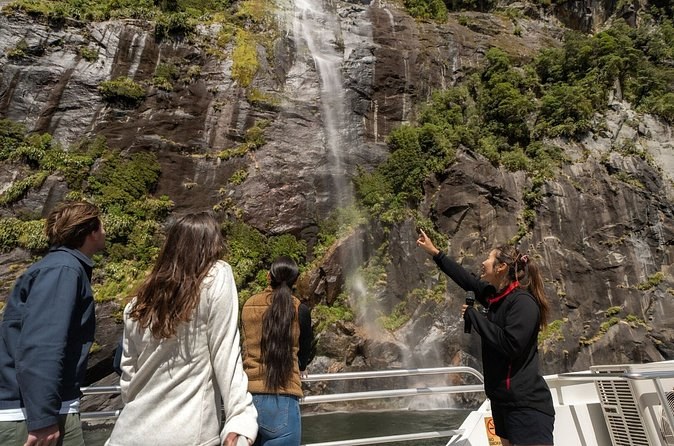
Milford Sound Cruise with Live Nature Guide and Hot Drinks
Up to two hours and fifteen minutes on the water with a nature guide on board, a commentary app in several languages, and free tea and coffee.
From $116 per person
Check AvailabilityMost of Milford Sound's wildlife lives on the water's edge, and you see it from the boat. Fur seals are the likeliest, tawaki the rarest, and kea meet you on the road in. Here is what you may see, when, and which of the Milford Sound New Zealand tours give you the best chance.
The fiord and its road hold three kinds of wildlife: the animals of the water, the birds of the forest and the parrots of the mountains. None of them can be promised on your day. Your odds depend on the season, the boat and a bit of luck.
| Animal | Where | When | Your chances |
|---|---|---|---|
| Tawaki (crested penguin) | The fiord's shore, from the boat | July to November | Possible in season, never certain |
| New Zealand fur seal | Rocks and water inside the reserve | All year | The likeliest sighting |
| Bottlenose dolphin | The fiord | Any month | Occasional |
| Kea | The road, near the tunnel | All year | Often, at the road stops |
| Forest birds and bats | The Eglinton Valley | All year | Birds on the forest walks |
| Black coral | The steep inner northern wall, deep | All year | Divers only; not from the boat |
The Fiordland crested penguin, called tawaki in Māori, is one of the rarest of New Zealand's mainland penguins. DOC puts the population at 2,500 to 3,000 breeding pairs, and it has been falling since the 1950s. Tawaki can be seen in the fiord.
Your best chance is the breeding season, July to November. You may also see one while they moult, from mid-January to early March. They are timid, and disturbance can make a nest fail, so DOC asks you never to approach a bird or a nest.
New Zealand fur seals live in these waters all year, and one cruise names a Seal Rock among its stops. Of all the animals here, they are the one you are most likely to see.
Bottlenose dolphins are occasional visitors, in DOC's word. You cannot plan for them, so treat a sighting as a bonus rather than a reason to pick one boat over another.
The Piopiotahi Marine Reserve covers the northern side of the fiord, from the village to Dale Point, where it meets the Tasman Sea. Your boat sails along it on every cruise. It has been a reserve since 1993.
You will not see the black coral from the boat; DOC says diving is the best way to explore the reserve. The name means "one native thrush", after the piopio.
Kea are clever mountain parrots found only in New Zealand, and they are nationally endangered. DOC estimates 1,000 to 5,000 remain. They are curious and love to investigate, and their call sounds like their name: "kee-aaa". On the road in, you meet them near the Homer Tunnel and at Monkey Creek.
In the forest near Lake Gunn you may hear South Island robins, kākā and mohua. DOC calls the Eglinton Valley a stronghold for native birds, and for both of New Zealand's native bats.
Size matters more than anything else for wildlife. A smaller boat can nose in closer to the rocks, and a nature guide knows where to look. Here is how the day boats compare, going by what each operator publishes.
| Boat | How many aboard | Who talks you through it | Why it suits wildlife |
|---|---|---|---|
| Cruise Milford | Filled to half its capacity | The skipper | A smaller boat that gets closer |
| Mitre Peak Cruises | Up to 75 | The skipper | The smallest operator, with frequent stops |
| Southern Discoveries | Up to 75 | A nature guide on board | Up to 2 h 15 min, with a guide to spot for you |
| RealNZ | Up to 180 | An app, or live commentary | A 2-hour option for more time |
| Pure Milford | Up to 199 | The crew | Outdoor decks on a catamaran |
| Overnight boats | 22 or 64 | The crew; a nature guide on the Mariner | Kayaks or a tender boat at the quiet end of the day |
Compare the smaller boats and the nature-guide cruise side by side.
The overnight boats have the fiord almost to themselves after the day boats leave. You can paddle a kayak or ride a tender boat close to the shore in the evening.
Sandflies, namu in Māori, are the wildlife nobody comes for. They bite. Every operator tells you to bring insect repellent, and DOC's advice for the road says the same.
The tawaki, kea, marine reserve and forest-bird facts are DOC's, checked 21 September 2026. The kea deaths are from DOC's release of 11 July 2024. Boat sizes, guides and what each boat offers come from the operators' own booking pages, captured the same day.
Up to two hours and fifteen minutes on the water with a nature guide on board, a commentary app in several languages, and free tea and coffee.
From $116 per person
Check Availability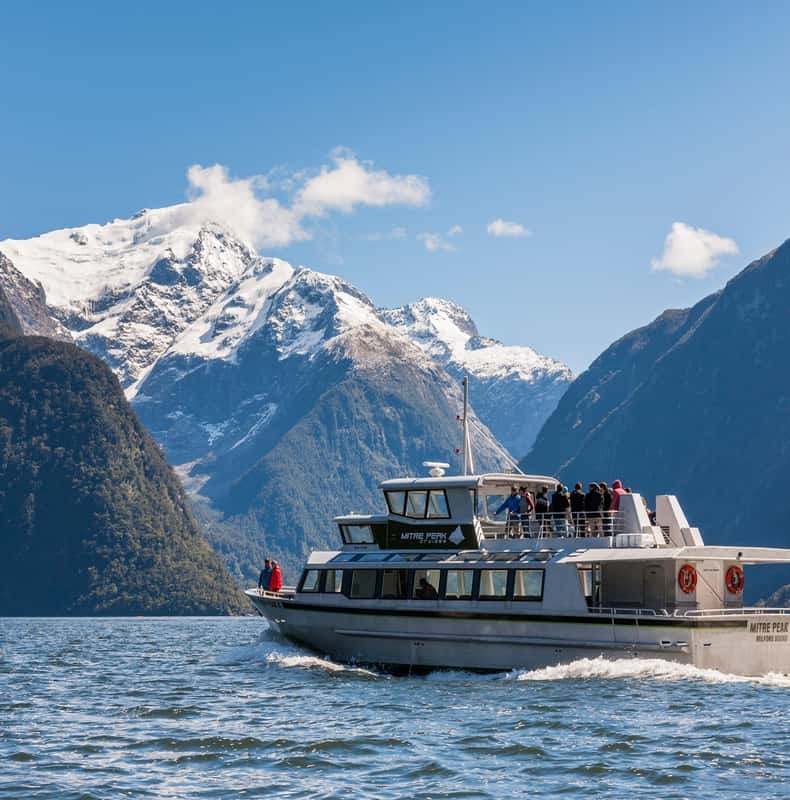
A 2-hour small-boat cruise with frequent stops along the walls, indoor and outdoor viewing areas, live commentary and free hot drinks.
From $96 per person
Check Availability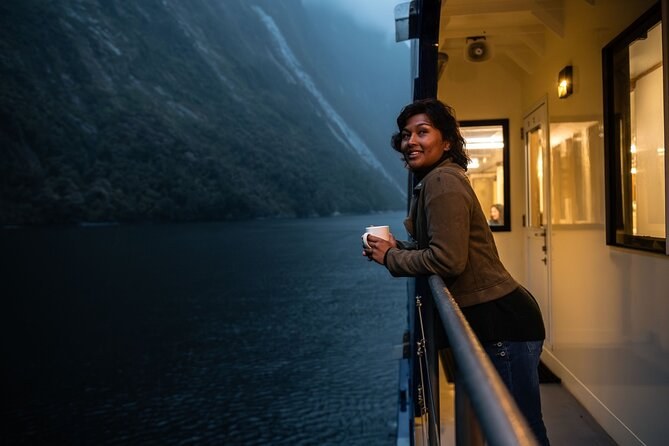
An overnight cruise priced per cabin of up to two: an en suite cabin, dinner, breakfast, and kayaks or tender boats. Non-refundable.
From $782 per cabin (up to 2)
Check AvailabilityNext: see the things to do, read the road guide, or compare every tour on Milford Sound Tours.